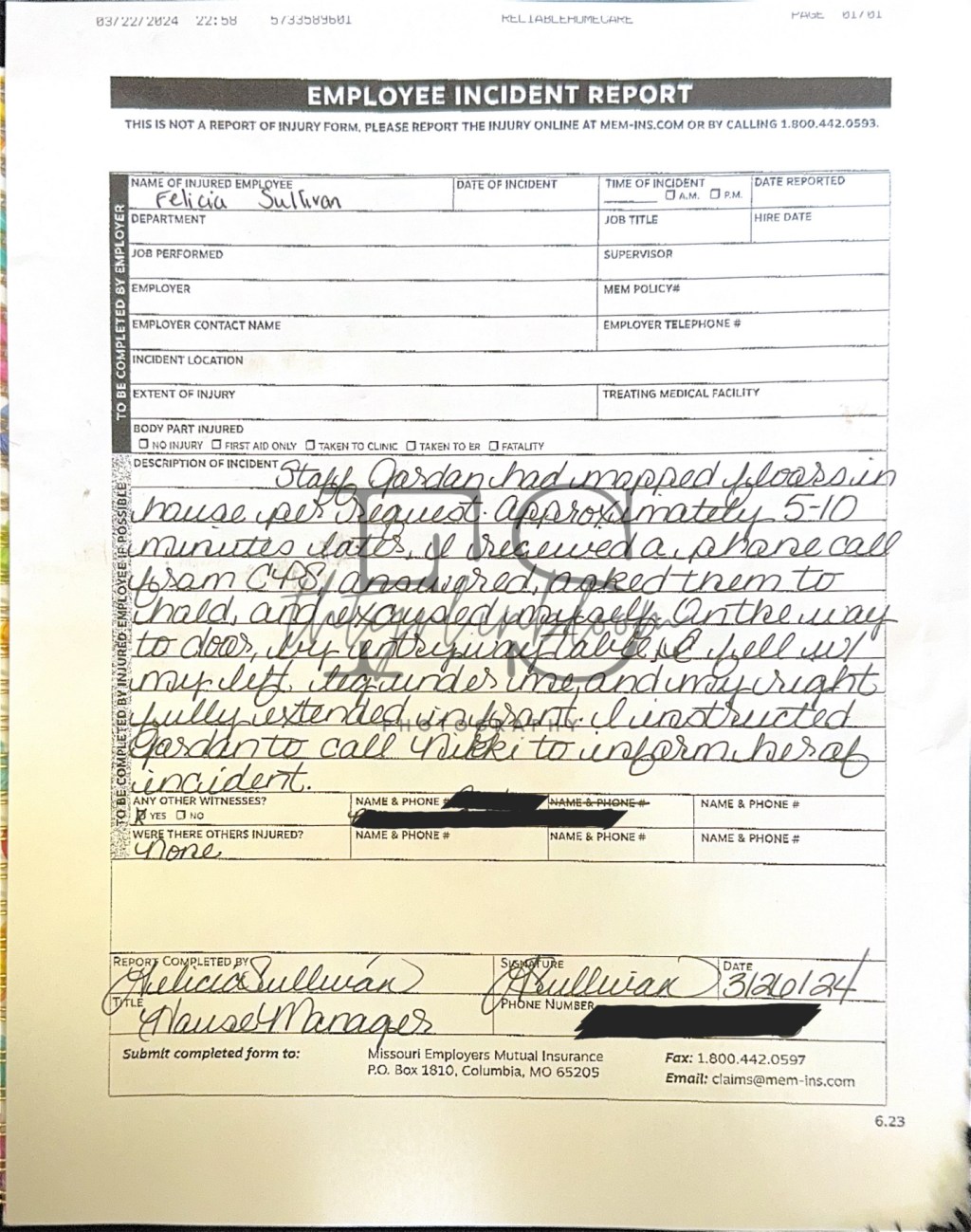
— employee incident report —
“staff, [redacted], had mopped floors in house per request. approximately 5–10 minutes later, i received a phone call from [redacted]. i answered, asked them to hold, and excused myself. on the way to door, by entryway table, i fell w/ my left leg under me and my right leg fully extended in front. i instructed [redacted] to call [redacted] to inform her of incident.”
that’s what the report says. simple. flat. black ink on white paper. it doesn’t tell the truth of what it felt like. it doesn’t capture the sound my body made when it hit the floor, or how fast everything changed. it doesn’t tell you about the pain that shot through me like lightning, or how it never really left.
march 22, 2024 started like every other day. i clocked in, checked the schedule, made sure my staff had what they needed, and focused on the people i cared for. one of my staff had mopped the floors—routine, ordinary, nothing unusual. minutes later, i received a call about my child. it felt urgent, so i told my staff to hold things down and stepped toward the front door to take it.
i never made it there.
as i crossed the entryway, my foot slid out from under me. my left leg twisted beneath me, my right leg shot forward, and i hit the floor hard. my tailbone slammed upward, a sharp jolt that made my entire body lock up. i didn’t have time to react, to brace myself, to drop the phone or the consumer book in my hand. everything went white for a moment—the kind of pain that stops time.
i remember the sound of my own breath catching, my heart pounding, and the silence that followed before my staff realized what had happened. they called my boss. they called the office. everything moved fast after that.
my boss and area supervisor arrived quickly. they helped me up—carefully, slowly—and into the area supervisor’s truck. i tried to hold it together, to stay composed, but the pain was unbearable. every movement sent shockwaves through my body.
we went to urgent care first. they planned to run imaging, but when the staff saw how severe the pain was, they decided i needed an ambulance to get to the emergency room safely. i could barely process what was happening.
the paramedic who arrived introduced himself and told me he was the father of one of my coworkers. i told him how much i admired his daughter’s work ethic. he smiled, and for a moment, the fear loosened its grip. when he said he had to administer fentanyl for the pain, i hesitated. i told him i didn’t want it—that i was scared. he explained every step softly and with care, his voice calm and steady. i let him help me. i trusted him. kindness like that stays with you.
the ride to the hospital was a blur of lights and quiet reassurance. the pain dulled, but it was still there, pulsing deep. i remember gripping the side rails of the stretcher and staring at the ceiling, trying to focus on anything but my body.
when we arrived at the er, my area supervisor was waiting. my wife showed up soon after. i was exhausted, scared, and trying to hold it together. while i was being examined by doctors and nurses, my supervisor struck up a private conversation with my wife—one that had nothing to do with my injury. she brought up our polyamorous relationship. unsolicited. unprovoked. completely inappropriate. my wife handled it gracefully, but when i found out later, i felt humiliated. i was lying there in pain, vulnerable, and still being judged for who i am.
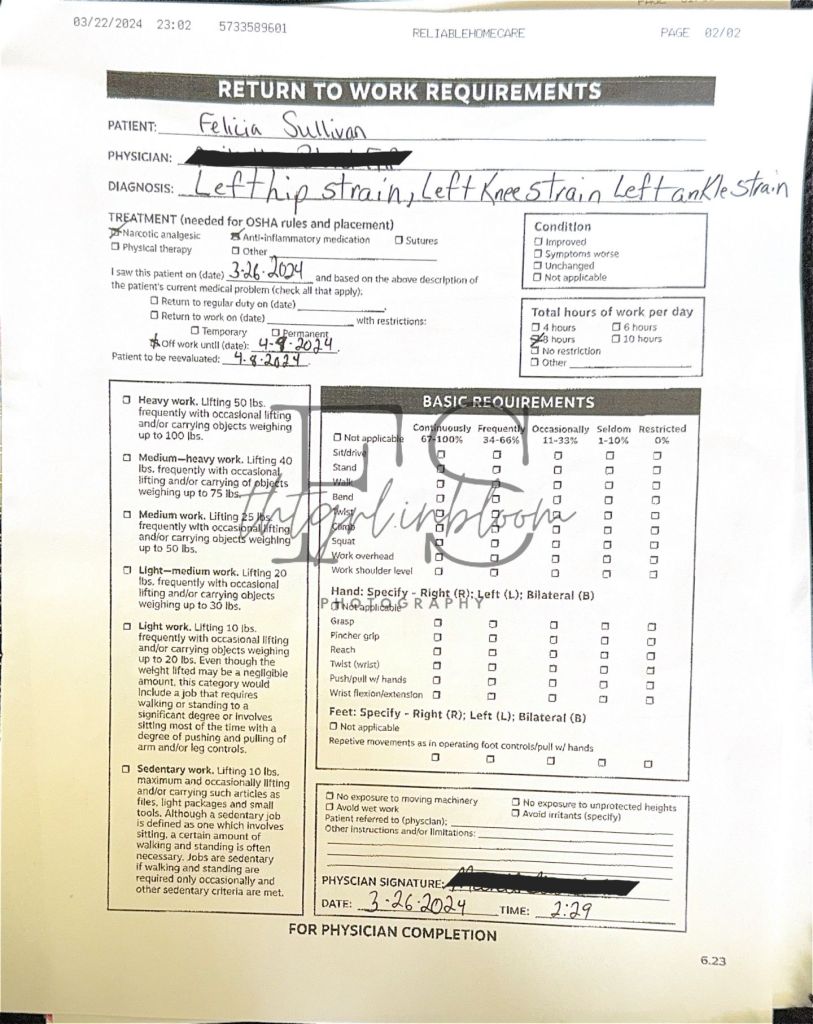
after several tests, i was diagnosed with left hip, knee, and ankle strains. i was sent home with crutches, a boot, and instructions to rest. i didn’t have many answers—just bruises, pain, and a vague assurance that workers’ compensation would reach out.
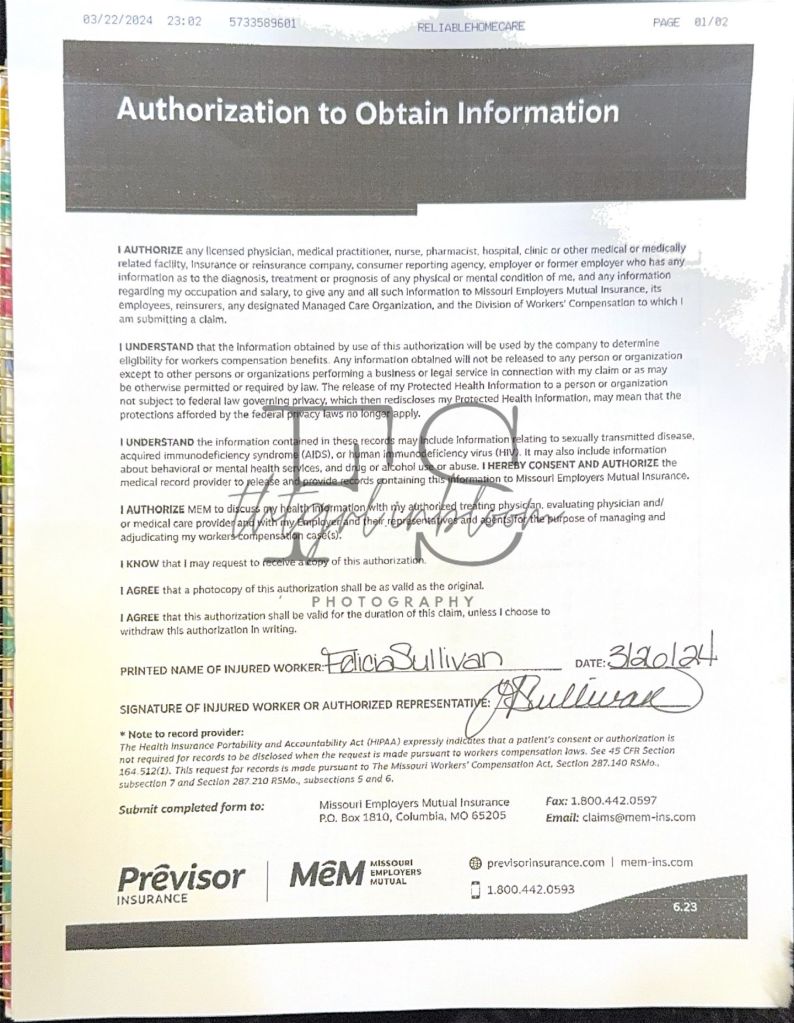
a few days later, my area supervisor called to schedule a work clearance appointment. i saw my primary care doctor on march 26, 2024, and filled out the required paperwork: the employee incident report, the authorization to release medical information, and every other form they asked for. before that appointment, my program manager called to ask about a prior event i’d attended. she said she was relieved to hear everything had gone smoothly, then hung up. i didn’t hear from her again until after my doctor’s appointment.
my doctor told me to stay off work until april 8, 2024, to give the medications time to help and the inflammation time to ease. i submitted all the paperwork to my supervisor and waited. on march 27, i received a call from mem, the workers’ compensation carrier. they assigned me a claim representative, gave me a claim number, and explained how to contact her by phone, text, or email. she told me i had an appointment scheduled with an orthopedic specialist in a nearby town and asked if i needed transportation. i told her i didn’t.
then came the first crack in the system. i was told my primary visit wouldn’t be covered because my doctor wasn’t part of the approved network. another obstacle. another blow. no answers, just another layer of frustration.
on march 29, my program manager called again to check in. she told me to direct any concerns to her moving forward. i updated her about a timesheet issue i’d been fixing and told her about my upcoming orthopedic appointment. i also made sure everything at the house was in order—activity schedules, menus, notes—because even from home, i wanted things to run smoothly.
as the month ended, the weight of it all started to sink in. i had gone from being a dependable, trusted part of the team to someone sitting at home, waiting for instructions. the silence grew louder with every passing day. the people i had worked alongside—people i supported and cared for—began to drift away. i could feel it happening, and there was nothing i could do to stop it.
then came the mental toll.
worry. depression. anxiety. panic. medication after medication.
and beneath all of it—the pain. the pain that never really stopped.
my job broke me in ways i couldn’t count. it took so much from me, but it didn’t take all of me. i’m still fighting. i’ve been fighting every day since. and in time, i hope you understand that fight.
imagine waking up at six in the morning, the first light barely slipping through the curtains. your body feels heavy, foreign. your eyes ache from nights of half-sleep. you’re exhausted—not just tired, but hollowed out. every small movement reminds you of what happened. the pain isn’t sharp anymore; it’s deep, constant, and alive. it’s there when you wake up, when you sit down, when you breathe.
the nights are worse. you toss and turn, searching for a position that doesn’t exist. you wake your partner without meaning to, because sometimes the pain is too much to carry alone. sometimes, you just need to be reminded that someone else is there.
the helplessness cuts deep. needing help with simple things—getting dressed, sitting, standing, bathing—feels like losing pieces of yourself. every step burns. your muscles protest. your body refuses to cooperate. thirty-six years old, and you need help just to move through the day.
for months, i did everything right. i followed orders, took the medications, kept every appointment, reported everything as required. but no matter how much effort i gave, it was never enough. there were days when i couldn’t get out of bed. days where i felt like a stranger inside my own body. there’s a certain heartbreak in doing everything right and still falling apart.
the good days came and went like illusions—brief glimmers of hope that maybe things were turning around. every time i felt progress, another wave of pain hit harder. it became a cycle: push forward, collapse, repeat.
i’ve spent eighteen years caring for others—working in healthcare, giving everything i had to people who needed me. i never imagined that one workplace fall could rewrite everything. but it did.
at first, everyone seemed supportive. they checked in, offered help, said all the right things. then, little by little, it faded. calls stopped. messages slowed. i still helped from home—making schedules, taking calls, setting appointments. i couldn’t just walk away from the people who relied on me.
but over time, my responsibilities were taken away. one by one. until there was almost nothing left. and then one day, i found out my position had been posted. no one called to tell me. i stumbled upon it myself. my name had been replaced by a job listing.
i stared at it, numb. i had believed i would return. i thought they were holding my place. i thought i still mattered. but in the end, i was wrong.
the betrayal was quiet but deep. i had poured my heart into that job, sacrificed so much, and when i needed them, they let me disappear. i wasn’t even given a chance to say goodbye to the people i cared for.
i sought legal advice—not because i wanted to fight, but because i needed to understand. workers’ comp is confusing, and i was lost in it. but once word spread that i had hired an attorney, everything changed. suddenly, i was treated differently. distant. cold. like i had become the problem.
my injuries were real—partial tears in my pcl and hip, inflammation in my sacroiliac joints—but the physical pain wasn’t the hardest part. it was the emotional damage. the feeling of being discarded. of realizing that after years of loyalty, i was replaceable.
now, at thirty-six, i wake up in a body that no longer feels like mine. i rely on medication to make it through the day. my wife helps me with my ADLS, on top of working a full time job.. i’ve always been strong, independent, capable—and now, i need help for the simplest things.
still, i smile. because that’s what people expect. they don’t see the panic, the exhaustion, the nights i can’t sleep. they don’t see the pain, the weight, or the silence that follows being forgotten.
this changed me. i don’t hate them. but i ache—because despite everything i gave, i was still so easily replaced. so easily forgotten. so easily cast as the problem.
this is only the beginning of the story.
for now, we start here.
with ink + bloom, 🌻
 Whispered Words | thtgrlinbloom, 🌻
Leave a comment